


Most indoor growers spend a lot of time choosing lights, pots and potting mix, and almost no time thinking about the air around their plants. Yet stale air is behind many of the problems people blame on everything else: weak stems, mold on the soil surface, fungus gnats, slow drying after watering and leaves that never quite look crisp.
In this guide you will learn what air circulation actually does for edible plants, how to tell if your setup needs more of it, which type of fan suits a windowsill, a shelf or a grow tent, and how to place and time it so your herbs and greens get a gentle breeze instead of a hurricane.
Why indoor plants need moving air
Outdoors, plants are almost never in still air. Even on a calm day there is a constant, light movement that you barely notice. Indoors, especially in a corner, on a shelf or inside a closed tent, the air around the leaves can sit almost motionless for hours. That changes several things at once.
Stronger stems
When a stem is pushed back and forth by a breeze, the plant responds by building thicker, sturdier tissue. Gardeners sometimes call this mechanical stimulation. Seedlings grown in completely still air tend to be thin and floppy, and they often fall over once they get taller. A light, steady breeze is one of the simplest ways to get compact basil, tomatoes and peppers that hold themselves up.
Fewer mold and mildew problems
Leaves release moisture all the time. In still air, that moisture forms a thin humid layer right around the leaf surface. Powdery mildew, gray mold and similar problems love that layer. Moving air breaks it up and helps leaves and the top of the soil dry faster after watering, which also makes the surface less attractive to fungus gnats.
Better gas exchange
Plants take in carbon dioxide through tiny pores in their leaves. In a closed space, the air right next to the leaves can become slightly depleted while the rest of the room is fine. Gentle circulation keeps fresh air reaching the leaf surface, so the plant can keep working at a normal pace under your lights.
More even temperature
Grow lights, even efficient LEDs, create pockets of warmer air at the top of a shelf or tent. A fan mixes that air so the top leaves are not much warmer than the bottom ones, and it helps carry heat away from the light fixture itself.
Signs your setup needs better airflow
You do not need special instruments to notice a circulation problem. Look for these clues:
- The top of the potting mix stays wet for days after watering.
- White, fuzzy or gray patches appear on the soil surface or lower leaves.
- Seedlings are tall, thin and lean or fall over easily.
- Small black flies hover around the pots when you water.
- The air inside a tent or cabinet feels noticeably warmer or more humid than the room.
- Condensation forms on the walls of a mini greenhouse or the inside of a tent.
One sign on its own is not proof, because overwatering and low light cause some of the same symptoms. But if you see two or three of them together, airflow is a good place to start.
Choosing the right fan for your space
The best fan is usually the smallest one that moves the air gently through the whole planting area. Bigger is not better: a strong fan blowing directly on tender herbs can dry and bruise the leaves.
Windowsill and countertop gardens
For a few pots on a windowsill or a small countertop garden, a compact USB desk fan is usually enough. Many plug into a phone charger, are quiet and use very little power. Look for one with at least two speed settings and an adjustable head, so you can aim it slightly above the plants rather than straight at them.
Shelving units and plant stands
On a multi-level shelf with lights on each level, small clip-on fans are the easiest option. They attach to the side of a shelf or a post and can be angled across each level. One fan per level works well for most home setups, especially if the shelves are deep or backed against a wall.
Grow tents and closed cabinets
Inside a grow tent you usually want two kinds of airflow. A clip fan or two inside the tent moves air around the plants, and an exhaust fan with ducting pulls warm, humid air out and lets fresh room air in through the lower vents. For a small hobby tent, a basic inline fan on the lowest useful speed is often plenty. Many models come with a speed controller, which is worth having so you can match the airflow to the season.
Features worth paying for
- Quiet operation. If the garden is in a kitchen, bedroom or living room, noise matters more than raw power.
- Oscillation. A fan that slowly turns side to side spreads air more evenly and avoids hitting one plant all day.
- Variable speed. Lets you start gently with seedlings and increase as plants mature.
- Sturdy clip or base. A fan that slips and falls into a tray of water is a safety problem.
Where to place the fan
Placement matters as much as the fan itself. The goal is to see leaves moving slightly, like they would on a calm outdoor day. If leaves are flapping constantly or bending over, the airflow is too strong or too close.
- Aim the fan across the canopy or just above it, not straight down onto the plants.
- Keep it far enough away that the closest leaves only flutter. With a small desk fan, that is often around 30 to 60 cm, depending on speed.
- In a tent, place the inside fan low on one side to push air across and up, and let the exhaust pull from the top on the opposite side. This creates a gentle loop through the plants.
- On a shelf, angle the fan from the side so the air travels along the length of the shelf rather than hitting the back wall.
- Do not point the fan at the soil of seedling trays all day; very small seedlings can dry out quickly.
A quick test
Hold a light strip of tissue paper at different spots among your plants. If it moves softly everywhere, the setup is working. If it hangs still in one corner, adjust the angle or add a second small fan. If it whips around near the closest plant, move the fan back or lower the speed.
How long to run the fan
There is no single rule, but some simple patterns work for most home gardens.
- Seedlings: start with a very gentle breeze for a few hours a day once the first true leaves appear, then increase gradually over a week or two.
- Established herbs and greens: many growers run circulation fans whenever the lights are on, since that is when the plants are most active and the lights add heat.
- High humidity or after watering: running the fan a bit longer helps the surface dry and reduces mold risk.
- Cold rooms in winter: a fan can make a cool space feel cooler for the plants. Use a lower speed or shorter periods if leaves look stressed.
A simple outlet timer, like the ones many people already use for grow lights, makes this effortless. You can put the fan on the same timer as the lights or on its own schedule.
Common mistakes to avoid
- Blasting the plants. Constant strong wind dries leaves, tears tender growth and can cause curled or crispy edges.
- Only exhausting, never circulating. In a tent, the exhaust fan removes air, but the plants still need movement inside.
- Forgetting the lower levels. On a shelf, the bottom level often gets the least air and the most humidity.
- Ignoring dust. Fan blades and grills collect dust that reduces airflow and spreads onto leaves. Unplug and wipe them every few weeks.
- Running cords near water. Keep plugs and power strips above the level of trays and reservoirs, and check that every cable is secure.
- Replacing good watering habits with airflow. A fan helps soil dry, but it cannot fix pots without drainage or constant overwatering.
Summary
Moving air is one of the cheapest upgrades you can make to an indoor edible garden. A gentle breeze builds sturdier stems, helps leaves and soil dry, reduces mold and gnat problems and evens out temperature under grow lights. For a windowsill, a small USB fan is enough; for shelves, use clip fans on each level; and in a tent, combine an inside circulation fan with a modest exhaust. Aim across the plants rather than at them, look for leaves that move softly, run the fan when the lights are on and adjust for seedlings, humidity and season. Keep the fan clean and the cords away from water, and your plants will notice the difference within a few weeks.
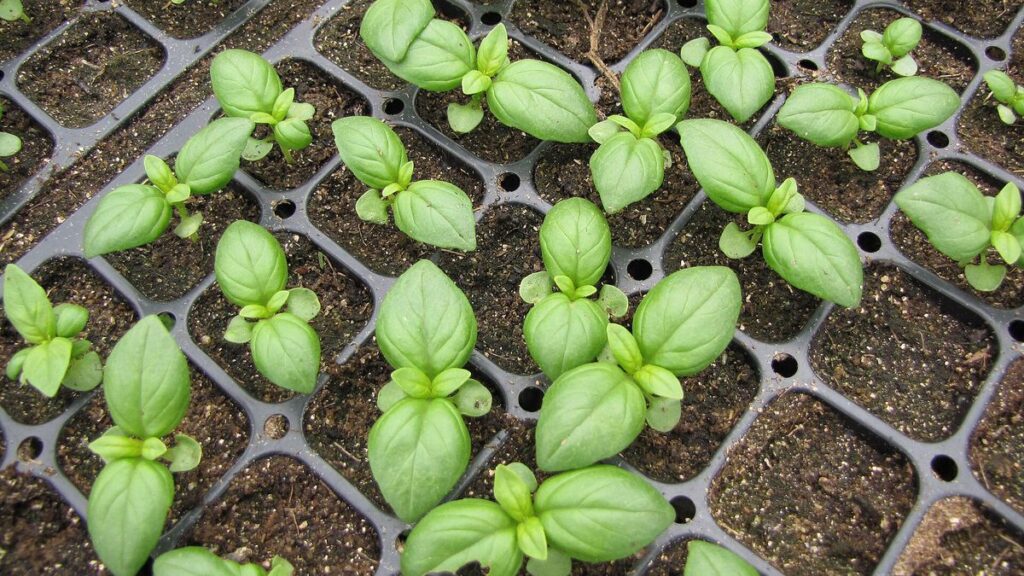
Photo: Starr-120608-7314-Ocimum basilicum-seedlings-Ulupalakua Ranch-Maui (24518452143), by Forest and Kim Starr, license CC BY 3.0 us, via Wikimedia Commons. Cropped.